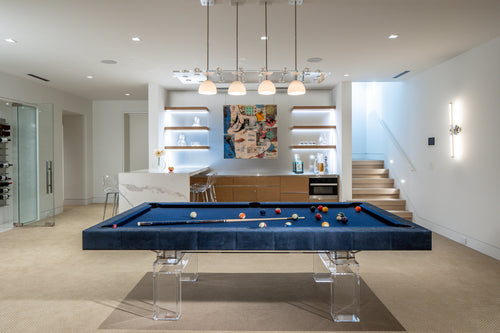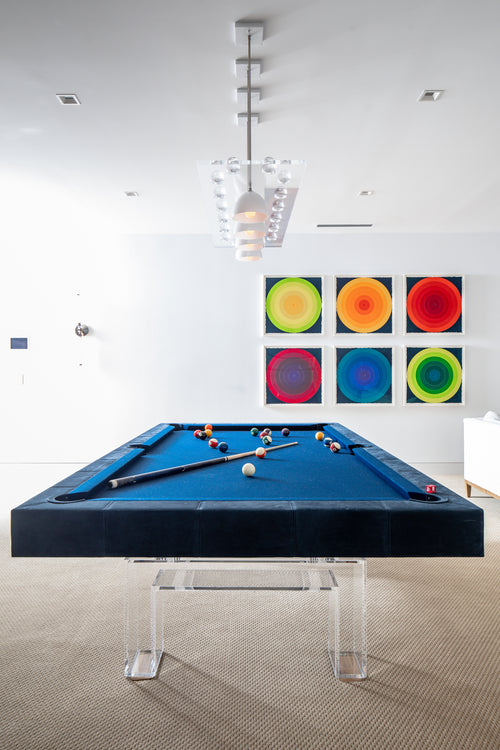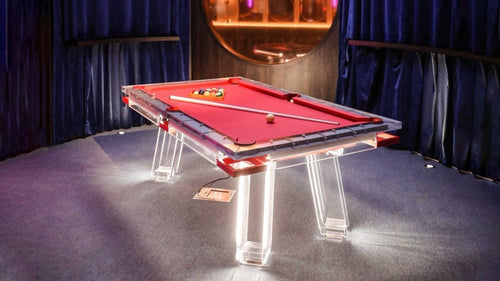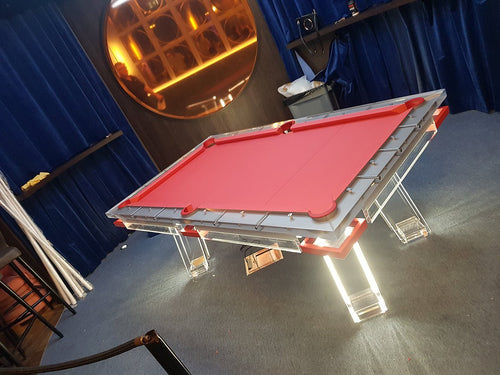


Enjoy our modern designs
Technique & Systems
The Diamond
System
How to use the table’s own geometry to calculate simple one-rail bank and kick shots with precision—turning guesswork into a repeatable reference.
This version covers the simplest one-rail mirror method: label the target pocket as 0, count the adjacent diamonds as 10, 20, and 30, then aim at the matching value on the opposite rail. It is a starting framework—clean, practical, and usable at the table.
The Concept
What Is the
Diamond System?
The Diamond System is a way of using the table’s rail markers—the diamonds—as reference points for kick and bank shots. Instead of relying entirely on feel, you assign simple values to the diamonds nearest your target pocket and use those values to build a repeatable aiming line.
For this article, the system is intentionally limited to its simplest form. The target corner pocket is 0, and the diamonds on the two adjacent rails are counted 10, 20, and 30. That keeps the method internally consistent and avoids mixing it with separate extended-number systems that use different scales and different rules.
Why It Matters
Why It
Matters
Most players learn banks and kicks by repetition. That works, but it is slow and vague. A reference system gives you something cleaner: a starting line you can test, repeat, and refine.
The point is not to replace touch. The point is to stop guessing. When a direct path is blocked, the diamonds give you a visible structure for finding the angle instead of hoping your eye gets it right.
The diamonds are not decoration. They are the table’s built-in measuring system—visible geometry you can actually use.— On the Diamond System’s underlying logic
The Fundamentals
Basic Diamond
Counting
In this simplified version, the target corner pocket is 0. From that pocket, count outward along the two rails beside it: 10, 20, 30. That is the entire numbering system used in this article.
Mirroring Across Rails
The core idea is simple: match the cue ball’s value to the same value on the opposite rail. If the cue ball lies near 20, aim near 20. If it lies halfway between 20 and 30, aim halfway between 20 and 30. You are mirroring the position, not inventing a second numbering scale.
The Core Rule
Start with the target pocket as 0. Count the adjacent diamonds as 10, 20, 30. Then aim at the matching value on the opposite rail.
That means 10 aims at 10, 20 aims at 20, 30 aims at 30, and halfway positions are treated as halfway positions. Keep the stroke center-ball and the speed controlled so the geometry stays honest.
Application
The System
Step by Step
-
Identify the Target Pocket
Label the pocket you want as 0. Count outward along the two rails beside it: 10, 20, 30.
-
Locate the Cue Ball on That Scale
Find the nearest diamond value to the cue ball. If it sits between two diamonds, estimate the in-between value rather than forcing it onto a full number.
Half-diamond estimates are enough for most simple one-rail shots. -
Mirror That Value on the Opposite Rail
Aim at the same value across the table. A cue ball near 20 aims near 20. A cue ball halfway between 20 and 30 aims halfway between 20 and 30.
-
Use Center Ball and Controlled Speed
Side spin and power both change the rebound. Learn the clean line first with center-ball contact and a repeatable speed, then adjust later if you want to build in spin.
Do not mix spin adjustments into the base system until the base system is reliable.
Refinement
Between the
Diamonds
The first extension does not require a new numbering system. It only requires interpolation. If the cue ball is not exactly on 10, 20, or 30, estimate where it falls between them and mirror that same fractional position on the opposite rail.
Half-Diamond Adjustments
If the cue ball is roughly halfway between 20 and 30, treat it as 25 and aim at roughly 25 on the opposite rail. That keeps the article internally clean: same scale, same logic, just finer placement.
In Practice
Practical
Examples
Example 01
Cue Ball at 10, Target Pocket = 0
Near Rail10
Opposite Rail Aim10
StrokeCenter-ball
The most basic line. Match the value, keep the speed controlled, and watch the cue ball track into the target line.
Example 02
Cue Ball at 20, Target Pocket = 0
Near Rail20
Opposite Rail Aim20
StrokeCenter-ball
Same rule, wider angle. The value does not change just because the shot feels bigger.
Example 03
Cue Ball at 30, Target Pocket = 0
Near Rail30
Opposite Rail Aim30
StrokeCenter-ball
This is the outer edge of the numbering used in this article. Same mirror rule, same scale, no extra numbering invented.
Example 04
Cue Ball Between 20 and 30
Estimated Position~25
Opposite Rail Aim~25
Adjustment TypeHalf-diamond
No new system is needed here. Just estimate the in-between position and mirror it across the table.
What Goes Wrong
Common
Pitfalls
Pitfall 01
Using Side Spin Too Early
Spin changes the rebound. If you add English before you trust the clean line, you stop testing the system and start guessing again.
The Fix
Learn the base geometry first with center-ball contact and a repeatable speed.
Pitfall 02
Aiming at a Zone Instead of a Reference Point
“Somewhere near that diamond” is not a system. Sloppy reference points create sloppy rebound lines.
The Fix
Pick the exact diamond or exact halfway point you are using and commit to it.
Pitfall 03
Mixing Numbering Systems
A basic 0–10–20–30 mirror system is not the same thing as an extended multi-rail or high-number system. Borrowing rules from a different system makes the explanation collapse.
The Fix
Keep one scale per lesson. Master the basic mirror method first, then teach any larger system separately.
// Closing Thoughts
Start with 10, 20, and 30. Then add half-diamond estimates between them. Keep the system narrow until it becomes automatic. The real mistake is not simplicity—it is inconsistency. A clean limited system teaches far better than a bigger one explained badly.