

Enjoy our modern designs
Estimated Read Time: 3 mins
Workplace design, particularly in the context of open-plan and collaborative environments, has undergone substantial transformation from the mid-20th century to today. These changes reflect broader shifts in design philosophy, technological advancement, and evolving social expectations within the workplace.
Table of Contents
Early Open Plan Concepts and Historical Context
Although the concept of the "open plan" office gained traction in the modern era, large, open workspaces existed earlier. Notable examples include:
- Frank Lloyd Wright's Larkin Company Building (1904), Buffalo, New York: Featured open general office spaces centered around a skylit courtyard, complemented by custom metal furniture and lighting for a cohesive interior.
- The Rookery (1886), Chicago: Designed by Burnham and Root with a central court roofed in glass and iron, later reimagined with an ornate interior by Frank Lloyd Wright in 1905. While upper floors were typically subdivided into smaller offices, these buildings laid the groundwork for future open-plan environments.
Mid-20th Century: The Rise of Modern Office Planning
The Emergence of Bürolandschaft
In Germany, the Quickborner Team pioneered the concept of Bürolandschaft ("office landscape"), replacing rigid partitions with free-form layouts defined by movable furniture and screens. This approach emphasized communication and flexibility. Early adopters included the Buch und Ton offices (1961) and Krupp (1962).
Specialization in Space Planning
The rise of modern office planning led to the emergence of a specialized profession: Space Planning. Firms like ISD (Interior Space Design) and SLS Environetics focused on optimizing office layouts for efficiency, comfort, and adaptability.
Modular Furniture Systems
The need for flexible, organized workspaces led to the creation of integrated office systems. Notably:
- Robert Propst's Action Office (1964) for Herman Miller: A groundbreaking system combining work surfaces, storage, and partition panels.
- Other systems by Stephens, Zapf, and Morrison further expanded the options for modular office planning.
Ergonomics and Worker Comfort
Health concerns related to prolonged sitting spurred innovations in seating. Ergonomic chairs such as the Ergon Chair by Bill Stumpf and the Aeron Chair by Don Chadwick and Stumpf became workplace staples.
Openness and Visual Connectivity
Architects like Edward Larrabee Barnes and I.M. Pei incorporated transparency and light into office design. Barnes’s IBM World Trade offices (1974) emphasized floor-to-ceiling glass partitions, while Pei’s Dallas City Hall (1977) included a massive, naturally lit public atrium.
21st Century: Trends in Contemporary Workplace Design
Redefining Corporate Image
Today's offices often break from the sterile corporate mold. Companies now embrace bold, stimulating environments that reflect their brand identity and support collaborative workstyles.
Flexible and Multi-Layered Layouts
Modern office spaces often feature open staircases, double-height atriums, and layered layouts that promote transparency and interaction. Glass enclosures and exposed structural elements are common aesthetic strategies.
Encouraging Creativity and Interaction
Service-oriented firms design interiors that promote chance encounters and creativity. Hallways with alcoves and clustered workstations support impromptu meetings and informal collaboration.
Blurred Boundaries Between Work and Life
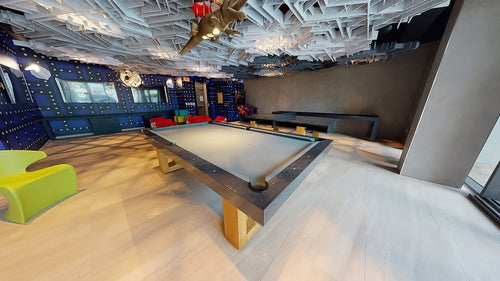
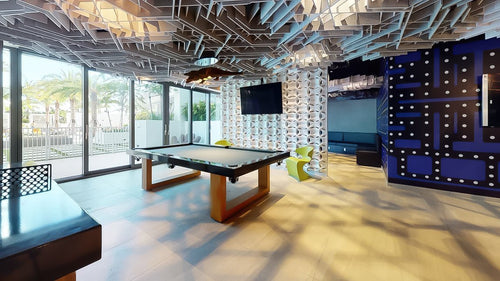
Offices increasingly feature amenities like cafes, lounges, recreational spaces, and even slides (e.g., Lego's Copenhagen office) to create home-like environments that enhance employee satisfaction.
Sustainability and Smart Technology
Green design principles now influence workplace architecture. Offices incorporate:
- Natural lighting and indoor greenery
- Energy-efficient systems
- Recycled materials
- Virtual modeling tools like Building Information Modeling (BIM) for planning and visualization
Adaptive Reuse of Buildings
Modern offices frequently occupy repurposed structures. Examples include:
- Gensler Headquarters (2011), Los Angeles: A 1970s bank reimagined as a collaborative, open-plan office.
- Facebook Palo Alto (2009), by Studio O+A: A converted lab outfitted with recycled materials and a casual layout.
Design Case Studies
- J. Walter Thompson, New York (2008): Renovated by Clive Wilkinson to eliminate private offices in favor of an open layout connected by a tree-like staircase.
- IMG Offices, New York (2008): Designed by Richard Meier to balance openness with hierarchical structure.
Conclusion
The evolution of workplace design reflects a broader societal shift toward openness, collaboration, and wellness. Moving away from partitioned offices and rigid layouts, contemporary workspaces emphasize flexibility, ergonomic comfort, sustainable design, and technological integration. These environments not only support productivity but also cultivate creativity, communication, and a sense of community among employees.