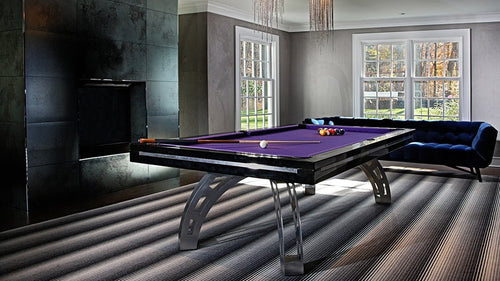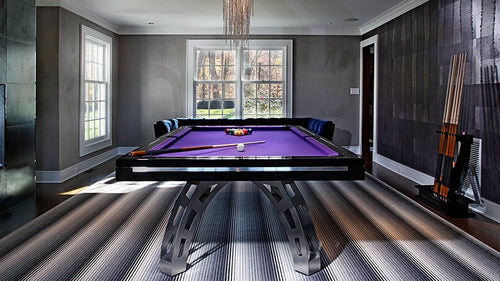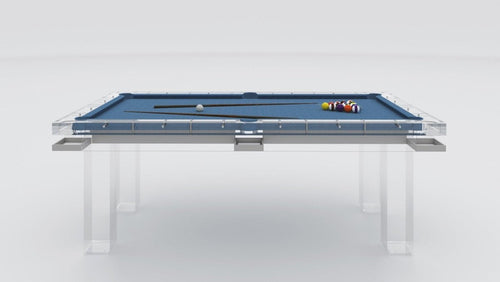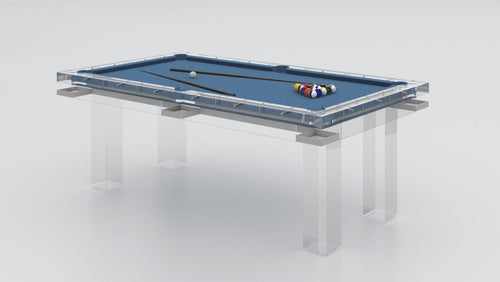


Enjoy our modern designs
In the world of high-end billiards, "level" is the ultimate goal. We spend thousands of dollars on precision-honed Italian slate and machinist-grade levels, all in pursuit of a table where a ball will travel in a perfectly straight line at any speed.
But here is the truth that most manufacturers won't tell you: A perfectly level table does not exist. Between the physics of the earth, the settling of your home, and the "living" nature of wood, the quest for a level table isn't about achieving a static state—it’s about managing a dynamic one. Here is the reality of the level, and how close you can actually get.
Table of Contents
1. The Enemy: Structural "Settling"
Even if we level your table to within .005" on Monday, by Friday, it might be off. Why? Because houses move.
- The High-Rise Sway: If you live in a luxury penthouse, your building is designed to sway. In a high-wind event, a skyscraper can move several inches. While you might not feel it, your 1,000lb table and the liquid-smooth surface of the slate certainly do.
- Subfloor Compression: A pool table is a massive "dead load." Over the first six months of installation, the weight of the table will compress the subfloor, the carpet pad, or the joists beneath it. What was level on Day 1 will inevitably shift as the house "accepts" the weight.
2. The "Living" Frame: Humidity and Expansion
Most luxury tables are built from solid hardwoods—Walnut, Oak, or exotic timbers like Ziricote. Wood is a "hygroscopic" material, meaning it breathes. It expands in the humid summers and contracts in the dry winters.
Even though the slate is stone, it is held up by a wooden frame. If the frame "breathes" unevenly, it can introduce micro-tensions into the slate bed. This is why a table in a climate-controlled room in São Paulo will play differently than one in the dry heat of Arizona.
3. The "Taper" of the Roll: Physics vs. Perception
Many players test a level by rolling a ball slowly across the table. If it "tapers" or curves at the very end, they assume the table is unlevel.
However, at ultra-low speeds, the texture of the cloth (the nap) and the cleanliness of the ball play a bigger role than the level of the slate. A single speck of dust or a tiny "pill" in the wool can deflect a slow-moving ball. In the industry, we call this the "effective level"—the table is structurally flat, but environmental factors create the illusion of a roll.
4. How Close Can You Actually Get?
In professional installations, we don’t use a carpenter’s bubble level. We use Machinist Levels.
- The Standard: A high-end machinist level is sensitive to .0005" per foot. To put that in perspective, a human hair is roughly .003" thick.
- The Goal: We aim for "within the bubble" across all directions—long rails, short rails, and diagonals. If we can get the slate bed flat to within the thickness of a piece of paper across its entire 9-foot surface, that is considered a "Master Level."
5. The "Maintenance" Mindset
Because "perfect level" is a myth, the best players and collectors view leveling as maintenance, not a one-time event.
- The 6-Month Check: You should have your table professionally checked and re-leveled six months after a new installation to account for floor settling.
- The "Shim" vs. The "Leg": High-end tables are leveled at two points: the feet (for the big shifts) and the slate-to-frame connection (using thin brass shims for the micro-adjustments).
The Verdict
You will never achieve a table that stays "perfect" forever. The goal is to achieve mathematical consistency. When you play on a table that has been leveled by a master installer, you aren't playing on a static object—you're playing on a finely tuned instrument that has been calibrated to defy the imperfections of the room around it.