


Enjoy our modern designs
Sport & Urban Culture
Tables in
the Park
Put a concrete ping pong table in a public square and something unexpected happens — strangers stop, watch, and play. How a simple slab of metal or stone became one of the most effective tools in urban design.
Cities across the world have rediscovered something beautifully simple: put a tough, weatherproof ping pong table in the right spot, and people will gather around it. What started as a small urban experiment in a few European plazas has spread to parks in New York, Seoul, Berlin, and São Paulo — and quietly become one of the more effective interventions in public space design.
The Phenomenon
The Rise of
Permanent Tables
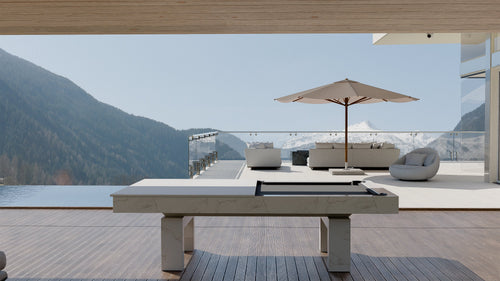
These tables are nothing like the fragile indoor varieties. They are built from materials chosen for permanence — poured concrete, steel frames, stone composites, thick aluminum slabs. They are designed to survive rain, wind, vandalism, and year-round foot traffic without warping, corroding, or losing their bounce. The intent is not temporary installation. It is infrastructure.
The idea behind permanent outdoor ping pong is not simply to provide equipment. It is to build a physical anchor point for interaction — a fixed object in public space that invites motion, creates occasion, and gives people a reason to slow down in places they would normally move through without stopping.
Poured Concrete
Weight + permanence
Steel Slab
Impact + corrosion resistance
Stone Composite
Aesthetic + durability
Thick Aluminum
Lightweight + weatherproof
Outdoor ping pong has become a global feature of urban life the same way basketball hoops once defined city blocks — visible, open, and belonging to everyone.— On the democratizing logic of public sports infrastructure
A Different Game
Outdoor vs.
Indoor Play
Playing outdoors changes the sport in ways that are subtle until they are not. Wind matters. Humidity shifts the ball's behavior. Light changes throughout the day. Sounds bounce differently off concrete and open air than they do in the controlled hush of an indoor hall. The game becomes less about technical precision at maximum concentration and more about adaptability, reading conditions, and keeping rallies alive in an environment that does not cooperate.
Indoor Hall
Precision and Control
Still air, consistent lighting, calibrated bounce surfaces, dedicated acoustics. The environment is engineered to remove variables — conditions that reward pure technical refinement and punish anything less than exact execution.
Park Table
Adaptation and Immediacy
Wind, ambient noise, variable light, sharper bounce on concrete or metal. The environment introduces variables that reward reading and reacting rather than executing set patterns. Regulars bring heavier balls, adjust their strokes, and develop a feel for conditions that indoor players never need.
The Street Culture Shift
The bounce on concrete or metal is sharper and louder than indoor play — the "ping" and "pong" echo through public squares and become part of the soundscape of a place. Some players actively prefer this version of the game. It feels raw, immediate, closer to street culture than the quiet focus of competitive halls. Outdoor ping pong is not trying to be indoor ping pong in the sun. It is something else — more social, less formal, and open to anyone willing to pick up a paddle.
What makes these tables powerful is less the game itself and more what they generate around it. A public ping pong table invites interruption. Someone walks by, pauses, watches a point or two, and often ends up in the next game. People who have never held a paddle feel welcome to try because the setting is casual, the expectation is imperfection, and the barrier to entry is essentially zero.
Unlike court sports that require reservations, teams, or skill thresholds, ping pong has a built-in simplicity: two people, one ball, a table, and the willingness to play. That ease creates a shared daily ritual — a small recurring occasion that makes a place feel lived-in rather than merely occupied.
Function 01
Cross-Social Mixing
Office workers at lunch, kids after school, tourists on a layover, retirees with serious ambitions of becoming the park champion. The table draws all of them to the same surface without any coordination required.
Function 02
Zero-Threshold Entry
No reservation, no team, no minimum skill. The game is legible at a glance and forgiving to beginners. Anyone who stops to watch can be playing within sixty seconds.
Function 03
Sport Visibility
Thousands of people who never think about table tennis see real play at arm's length. Sometimes it sparks curiosity that leads somewhere. More often it just gives someone a five-minute break from the city. Both outcomes are valuable.
Practical Realities
Engineering
the Outdoors
Cities that install permanent tables quickly discover that outdoor ping pong has its own engineering and maintenance logic. Materials must not absorb moisture or crack under thermal cycling. Playing surfaces cannot retain enough heat to burn players who touch them, cannot corrode from rain, and must maintain consistent bounce characteristics after thousands of impacts across years of use.
The communities that form around these tables adapt alongside the infrastructure. Regulars bring their own equipment calibrated for outdoor conditions — thicker paddles that resist humidity warping, heavier balls that hold a line in wind, portable nets for when permanent installations get damaged. Urban planners have learned to specify indestructible metal nets that survive daily use and weather, accepting the louder sound as the cost of longevity.
The Usage Reality
Some parks report that their ping pong tables receive more consistent daily use than their basketball courts or outdoor gym equipment. The reason is structural: ping pong requires almost nothing from the participant and produces a social payoff immediately. The barrier to entry is low enough that people use it spontaneously rather than planning around it. That spontaneity is what turns infrastructure into culture.
Global Scenes
A Movement with
Local Flavor
Every city that has embraced permanent outdoor ping pong has developed its own scene around the tables — a distinct social character shaped by the neighborhood, the climate, and the people who show up every day.
Berlin
Gritty and Fast
Concrete tables in courtyard spaces attract quick, aggressive play with minimal ceremony. The aesthetic is deliberately unpolished — industrial surroundings, players who treat the tables as genuinely serious sporting venues rather than novelties.
New York — Bryant Park
Community and Rivalry
A well-documented mini-community has formed around the tables at Bryant Park, with regulars, friendly rivalries, and spontaneous tournaments. The park's central Midtown location draws the widest possible demographic mix into a single, small contested space.
Seoul
Serious Footwork
Public park tables attract older players with developed technique and genuine competitive intent. The culture is more formal than Western street ping pong — regulars bring their own equipment, play with established partners, and treat park sessions as structured practice.
Barcelona
Late-Night Social Ritual
The city's outdoor culture extends ping pong well into the evening. Tourists, locals, and late-night players treat the tables as part of the city's broader social rhythm — an easy, spontaneous activity that fits naturally into the long Mediterranean evening.
The Bigger Argument
Play as
Public Infrastructure
Permanent ping pong tables represent a shift in how cities think about what public space is supposed to do. Not everything has to be commercial, high-tech, or programmed in advance. Sometimes the most effective public asset is a slab of metal or concrete placed in exactly the right spot — an object that invites motion, generates conversation, and creates the conditions for laughter without requiring anyone to plan, pay, or sign up for anything.
The tables work because ping pong is accessible across age, culture, and skill level in a way that few sports can claim. A retiree and a teenager can play a meaningful game. A tourist and a regular can share a table without a common language. That accessibility is not incidental to the tables' social function — it is the mechanism. The game's low barrier is what makes the interaction possible.
// Conclusion
The real legacy of the outdoor ping pong movement is not more places to play — it is more reasons for people to stop, stay, and share a moment in the middle of the city. A concrete slab, a metal net, and two paddles turn out to be enough to make a public space feel genuinely public.

A Magnet for
Strangers