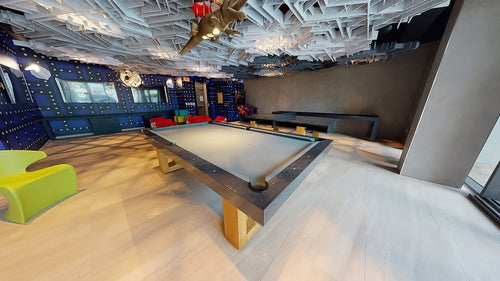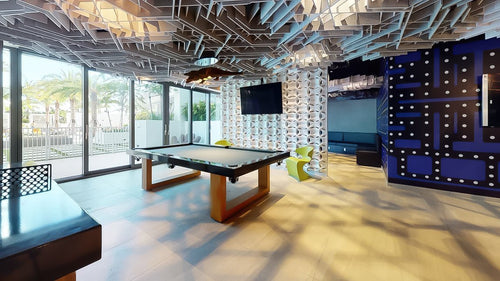


Enjoy our modern designs
Educational building design has evolved significantly, transitioning from historically imitative styles to contemporary environments that emphasize technology, social welfare, sustainability, and collaboration. This shift reflects a growing emphasis on flexible, human-centric spaces that respond to the needs of modern learners.
Table of Contents
Historical Context and Early Forms
In earlier centuries, educational buildings, especially colleges and universities, adopted architectural styles rooted in tradition. During the Middle Ages, institutions expanded, and their libraries grew large enough to necessitate dedicated spaces. Examples include the grand library of Durham Cathedral and the more intimate library at St. John's College, Oxford, both featuring timber-roofed halls with integrated shelving and tables. Dining halls resembled the great halls of castles, such as St. John's College's hall with Gothic arched windows, oak-paneled wainscoting, and a hammer-beam wooden trussed roof.
In the 19th century, American colleges embraced Greek Revival styles, as seen at Amherst and Washington and Lee. Later, the Gothic Revival became the "eclectic norm" for campus architecture, resulting in the term "collegiate Gothic." This style was exemplified by the University of Pennsylvania's dormitories, Yale's quadrangles, and Princeton's richly detailed interiors like the Graduate College refectory and the University Chapel—reminiscent of their Oxford and Cambridge counterparts.
Emergence of Modernism (Early 20th Century)
The early 20th century marked the rise of modernist architecture in education, prioritizing function, openness, and design unity:
- Functionalism and Openness: At the Bauhaus in Germany, Walter Gropius promoted a curriculum uniting fine arts with design and architecture. The Bauhaus building reflected these ideals with a four-story workshop block, glass curtain walls, flat roofs, and minimalistic interiors. It included a dormitory unit, supporting full-time student residency. Gropius's own office in Weimar embodied abstract geometric forms.
- Flexible Spaces: Mies van der Rohe's Crown Hall at the Illinois Institute of Technology featured a rectangular open interior with all-glass walls, a roof supported by external steel girders, and flexible interior layouts using movable partitions. His work, along with that of Gropius and Marcel Breuer at Harvard, helped steer American architectural education toward modernism.
- Integrated Design: Alvar Aalto's buildings, such as the Turun Sanomat office, displayed inward-sloping reinforced concrete columns that shaped elegant utilitarian spaces. His Technical Institute at Otaniemi included classroom wings and a lecture hall with tiered seating and concealed lighting.
- Public Visibility of Modernism: The 1939 Museum of Modern Art (MoMA) in New York, designed by Philip L. Goodwin and Edward Durrell Stone, introduced modernism to the American public through educational interior spaces and welcoming lobbies.
Contemporary Trends (21st Century)
Technology Integration and Advanced Learning Environments
- Educational buildings now accommodate sophisticated computer and communication systems.
- Libraries have transformed into multimedia hubs with computer stations, video facilities, music listening areas, and interactive play spaces.
- Schools leverage technologies like Building Information Modeling (BIM) to enable virtual walk-throughs and iterative design improvements.
Flexibility and Collaborative Learning
- Modern schools reject rigid layouts in favor of open, adaptable spaces conducive to collaboration.
- Designs aim to foster student comfort and enthusiasm.
- Reece High School in Tasmania (2003) features zones specifically designed for project-based learning.
- Libraries like the Seattle Public Library (2004) by Rem Koolhaas challenge traditional models, incorporating spiral ramps and light-filled, interconnected spaces.
Social Welfare and Human-Centric Design
- Evidence-based design supports cognitive and developmental outcomes.
- Schools prioritize health, safety, and accessibility.
- Educational facilities often connect with their communities, promoting parental engagement and hosting events.
- Innovative, socially responsible designs are emerging in rural and underdeveloped regions.
Sustainability and Green Design
- Many institutions now prioritize sustainable materials and energy-efficient systems.
- Libraries use recyclable materials and renewable resources.
- Gensler's Graduate Center for the New York School of Interior Design (2010) achieved LEED Platinum certification, demonstrating environmental stewardship.
Evolving Aesthetics and Adaptive Reuse
- Prestigious universities continue to invest in iconic, design-forward buildings.
- Smaller institutions often favor functionality over ornate facades.
- Eye-catching projects include Zaha Hadid's Evelyn Grace Academy (2011), featuring bold forms and integrated athletics spaces, and Thom Mayne's sculptural Cooper Union Academic Building (2009).
- The Seattle Public Library's glass-and-steel façade and vivid yellow escalators reflect a departure from tradition.
- The Liyuan Library in China (2012) integrates natural materials with contemporary style.
- Adaptive reuse projects, like the transformation of a department store into the New York Public Library's Science, Industry, and Business Library (1998), are increasingly common.
Conclusion
Today's educational buildings are dynamic, multifaceted environments. They support collaboration through flexible layouts, integrate technology for enhanced learning, and promote well-being through sustainable, inclusive design. This transformation reflects a broader commitment to adaptability, innovation, and the creation of learning spaces that inspire and empower future generations.