

Enjoy our modern designs
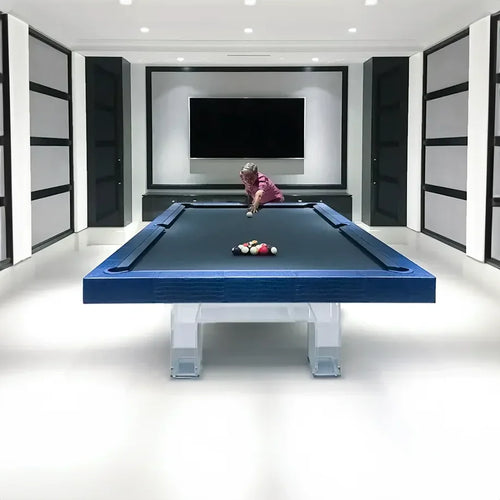
Every parent has the same vision: a beautiful game room where the family gathers on Friday nights, teaching the kids geometry and patience over a game of 8-ball.
The reality is often different. Standard pool is difficult. For a 7-year-old (and honestly, for many beginners), the experience consists of missing the ball, scratching the cue against the felt, and watching dad run the table. It leads to boredom, not bonding.
If your goal is genuine family interaction, the answer might not be a Regulation 8-Foot table. It might be Bumper Pool.
Here is why the "Obstacle Game" is the superior choice for young families.
Table of Contents
1. The "Whiff" Factor vs. The Rebound
In standard pool, the feedback loop for a beginner is brutal. If you miss the pocket, the turn ends. The game stops. There is no reward for "almost."
In Bumper Pool, the table is alive.
- Active Mistakes: If a child misses their target hole, the ball inevitably hits a rubber bumper. It bounces. It creates chaos. It might even roll into a scoring position by accident.
- Continuous Motion: The game feels faster and more exciting because the balls are constantly interacting with the obstacles. It holds a child's attention span far longer than the slow, tactical pace of straight pool.
2. The Great Equalizer
Standard billiards is a game of pure skill. If a parent plays a child, the parent has to "let them win" for the game to be competitive. Kids are smart; they know when they are being patronized.
Bumper Pool introduces Hazard Dynamics.
- The bumpers in the center of the table act as a randomness generator. A slight error in angle can send a ball ricocheting back at the shooter.
- This "chaos factor" levels the playing field. A beginner can get a lucky bounce and beat a seasoned player. It allows for genuine competition where the child has a real chance of winning on their own merit.
3. The Geometry of Reach
We often forget that a standard pool table is physically massive.
- The Reach Problem: On a 4-foot wide regulation table, a child (or a shorter adult) physically cannot reach a ball in the center without using a "bridge" stick—a clumsy, difficult tool for small hands.
- The Bumper Solution: Bumper pool tables are significantly smaller (usually rectangular or octagonal). A child can reach almost any shot from the rail without overextending. It removes the physical barrier to entry, allowing them to focus on the shot rather than their balance.
4. Safety in Small Spaces
Standard pool requires power. To break a rack of 15 balls, you need force. In inexperienced hands, this leads to balls flying off the table or cue sticks hitting the drywall (or a sibling).
Bumper Pool is a game of finesse, not force. The goal is to navigate a maze, not blast a cluster. The strokes are shorter, softer, and more controlled, making it a safer option for high-energy playrooms.
Conclusion: Choosing Engagement Over Tradition
There is a time for the grandeur of a full-sized tournament table. But if your immediate goal is to get your children off their iPads and interacting with you, Bumper Pool offers a lower barrier to entry and a higher "fun factor" right out of the gate.