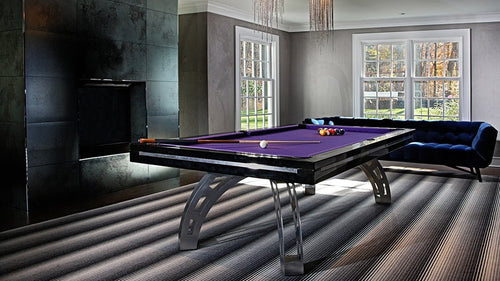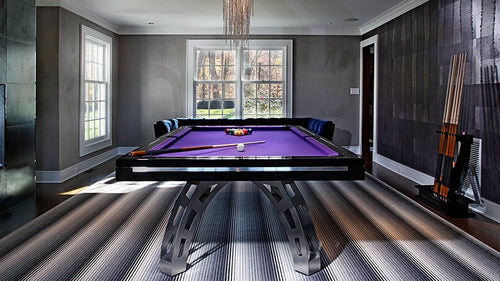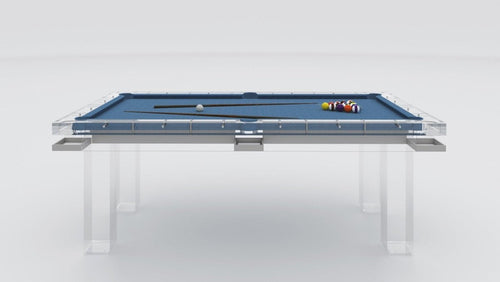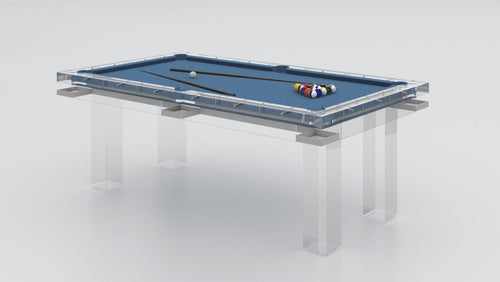


Enjoy our modern designs
In the world of high-end billiards, the "sound of the drop" is as important as the "clack of the break." When a ball disappears into a pocket, it should be met with a muted, organic thud—the sound of success.
For the connoisseur, the choice between bespoke hand-stitched leather and industrial molded plastic isn't just an aesthetic preference; it is a fundamental choice between a piece of fine furniture and a mass-produced recreational product. Here is why the "finish line" of your shot deserves a closer look.
Table of Contents
1. The Tactile Experience: Soft Landing vs. Hard Bounce
The primary function of a pocket is to arrest the momentum of a 6-ounce phenolic resin ball moving at high speed.
- Molded Plastic: Typically found on commercial or entry-level tables, these are made of hard polyethylene or rubberized plastic. Because the material is rigid, the ball often "rattles" or bounces off the back of the pocket if struck with too much power. Over time, these pockets can become brittle, leading to cracks that can actually scratch your expensive ball set.
- Hand-Stitched Leather: A bespoke leather pocket (often reinforced with a heavy iron core) acts as a natural shock absorber. The "give" of premium cowhide or buffalo leather kills the ball's momentum instantly. This prevents the "bounce-out" and provides that satisfying, deep acoustic signature that defines a luxury game room.
2. The Craftsmanship: Artistry in the "Shield"
When you opt for bespoke leather, you are commissioning a piece of artisanal leatherwork.
- The Shield: This is the visible front face of the pocket. In bespoke work, this is often "wrapped" leather, hand-tooled with custom patterns, family crests, or minimalist "blind" stitching.
- The Stitching: High-end pockets use waxed linen thread and a traditional "saddle stitch." This isn't just for looks; a saddle stitch is virtually impossible to unravel, ensuring the pocket won't fail even after thousands of games.
- The "Drop": In luxury tables, the "drop" (the bucket that holds the balls) is often lined with soft suede or felt to prevent the balls from clicking against each other, preserving their polish and preventing "burn marks."
3. Longevity and "The Patina"
Like a high-end pair of English boots or a luxury watch strap, leather pockets age with grace.
- Plastic's Lifecycle: Plastic and rubber pockets are subject to "UV degradation" and chemical breakdown. They eventually fade, chalk, or crack, requiring total replacement.
- Leather's Evolution: Bespoke leather pockets develop a patina. Over decades of play, the leather softens and deepens in color, absorbing the oils of the room and the history of the games played. With occasional conditioning (using a high-grade neatsfoot oil or beeswax), a leather pocket can easily last 50 to 80 years.
4. Integration: The "Seamless" Rail
In a custom-built table, the pocket isn't an "add-on"—it is integrated into the architecture of the rail.
Bespoke leather pockets allow for a "flush mount." This means the leather is thinned (skived) and tucked perfectly under the rail cushion. On a cheap table with plastic pockets, you’ll often see a "lip" or a gap where the pocket meets the wood. This isn't just a visual flaw; it can snag a player's sleeve or affect the bridge of a hand during a rail shot.
5. The Verdict: The Finishing Touch
If the slate is the "brain" of the table and the frame is the "body," the pockets are the finesse.
Molded plastic serves a purpose in high-traffic commercial environments where durability and cost-efficiency are king. But for a residential centerpiece—where the table is an expression of personal style—hand-stitched leather is the only choice. It is the difference between a "click" and a "thud," between a commodity and a legacy.