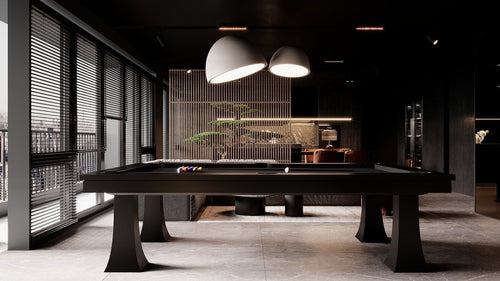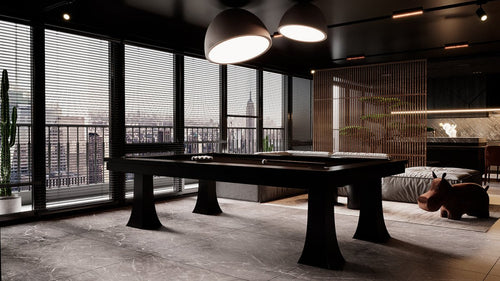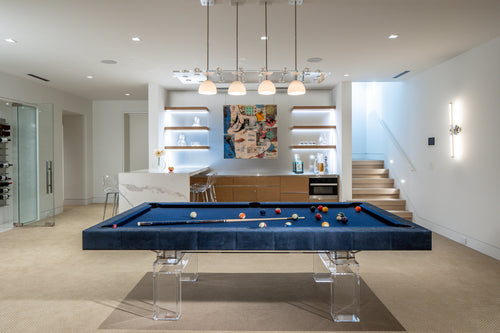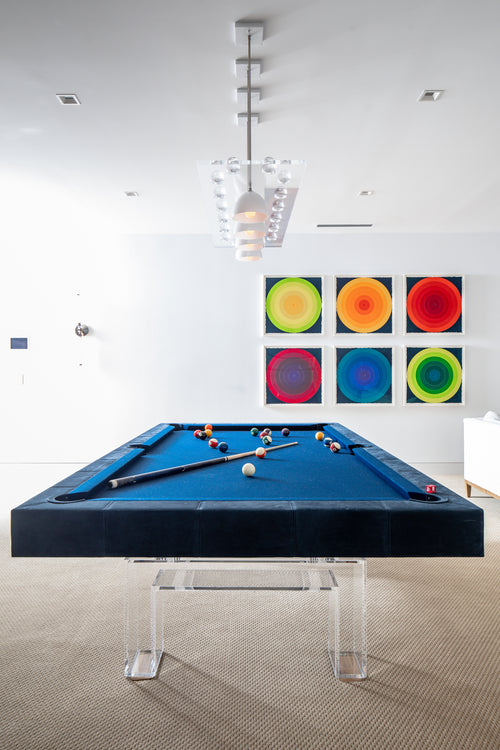


Enjoy our modern designs
When you look at a traditional pool table—specifically a "Ball and Claw" or a "Queen Anne" style—your eye is immediately drawn to the legs. They are the structural pillars of the table, but they are also the canvas for its most intricate design.
In the modern furniture market, you will see two tables that look similar from ten feet away, but one costs $4,000 and the other costs $14,000.
The difference is often found in how those legs were made.
We are living in the age of automation, where machines can replicate designs in seconds. But in the world of true luxury furniture, there is still a war being waged: The Robot vs. The Chisel.
Here is the real difference between CNC (Computer Numerical Control) machining and Old World artisan hand-carving.
Table of Contents
The CNC Revolution: Precision Without Soul
Most tables built today feature legs made by CNC routers. A computer reads a 3D file, and a high-speed spinning bit carves the design out of a block of wood.
- The Pro: It is fast, affordable, and chemically perfect. Every leg is identical to the millimeter.
- The Con: It lacks depth. Because a router bit spins, it cannot cut sharp internal corners. It leaves a slightly rounded radius in every crevice. Furthermore, a machine cannot replicate the unpredictable grain of wood; it cuts through everything blindly, often leaving a "fuzzy" finish that requires heavy sanding—which further blurs the details.
The Artisan Touch: Sharpness and Shadow
Hand-carving is a dying art. It requires a master woodworker to stand over a block of mahogany or walnut with a mallet and a set of steel gouges, chipping away the negative space one strike at a time.
It takes days, not minutes. But the result creates a visual impact that a machine simply cannot replicate.
1. The "Crispness" Test
This is the easiest way to spot a hand-carved leg. Look at the deepest part of the carving—for example, the space between the talons of a claw or the veins of an acanthus leaf.
- CNC: The corners will be soft and rounded.
- Hand-Carved: The corners will be razor-sharp. A chisel cuts the wood fibers cleanly, creating a crisp shadow line that catches the light differently. It looks "high definition."
2. The Undercut
This is the true mark of mastery. A CNC machine creates "2.5D" objects—it cuts from the top down. It cannot reach underneath a leaf or behind a scroll. A human carver can undercut the wood, creating true three-dimensional depth. You can almost slide your finger behind the petals of a hand-carved flower. This creates deep, dramatic shadows that make the leg look like it is alive, rather than just a stamped pattern.
3. The "Perfect" Imperfection
If you measure four CNC legs, they are identical clones. If you look closely at four hand-carved legs, you will find microscopic differences. Maybe the knee of the lion is slightly more muscular on one; maybe the scrollwork is a millimeter deeper on another. These aren't errors; they are the signature of the artist. It is the "Wabi-Sabi" aesthetic—the beauty found in the organic touch of the human hand. It proves that a person, not a program, made your furniture.
Why It Matters
Does a hand-carved leg hold the slate up better than a machine-cut leg? No. Structurally, they do the same job.
But you don't buy a luxury pool table just to hold slate. You buy it as a centerpiece. You buy it for the same reason you buy a mechanical Swiss watch instead of a digital quartz watch.
You are paying for the time, the heritage, and the sheer difficulty of the execution.
When you run your hand over the rail of a hand-carved table, you are connecting with a tradition that goes back centuries. You are owning a piece of sculpture that happens to be a pool table.