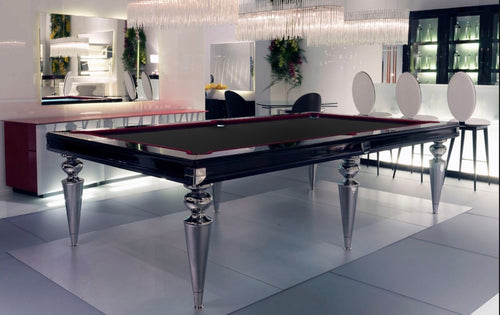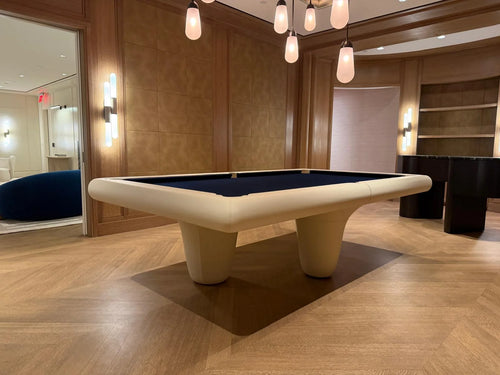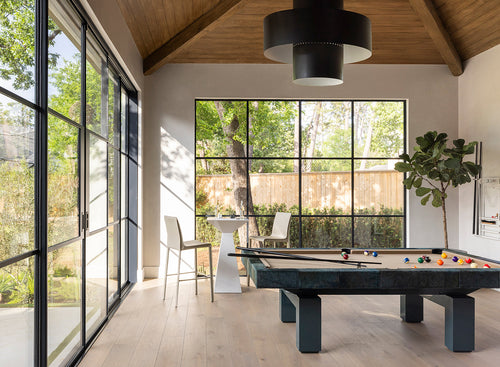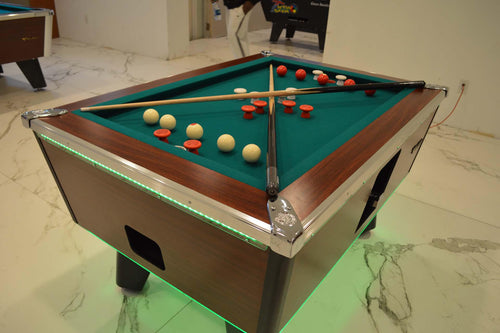


Enjoy our modern designs
A custom pool table needs more than a competent initial installation. Cloth wears, cushions age, frames settle, and moves require careful disassembly. Specialty finishes and convertible dining components may also need attention over the table’s life.
The right provider depends on the problem. A pool-table mechanic can handle many playing and assembly issues, but woodwork, metalwork, stone, glass, or powered equipment may require additional specialists.
In this guide
1. Start With the Manufacturer or Dealer
The original manufacturer, authorized dealer, or installer is usually the best first contact. That provider should know the fastening system, slate layout, cushion specification, finish, dining-top supports, and any proprietary mechanisms.
Before purchasing a table, ask who performs local warranty and post-warranty work. A manufacturer may use its own crew, dispatch a regional technician, or authorize qualified independent mechanics. Clarify which arrangement applies to your location.
Useful service questions include:
- Who handles routine leveling and reclothing?
- How far will the service team travel?
- Are travel charges separate from labor?
- Which parts must come from the factory?
- Can another qualified technician work on the table without affecting the warranty?
- Who services dining-top lifts or other powered components?
Design note: If the table is integrated with flooring, wall panels, lighting, or built-in seating, retain the room drawings as well as the table drawings.
2. Know What a Table Mechanic Handles
A qualified pool-table mechanic works on the systems that affect assembly and play. Typical services include:
- Precision leveling and frame assessment
- Slate seam correction and sealing
- Cloth replacement and limited cloth repair
- Cushion, facing, and pocket replacement
- Rail alignment and fastening
- Disassembly, moving, and reassembly
- Diagnosis of inconsistent roll, rebound, or pocket response
Custom experience is important. A mechanic accustomed only to standard commercial tables may not recognize concealed connections, unusual rail assemblies, stone bases, integrated storage, or dining-panel mechanisms.
For a performance complaint, ask the mechanic to diagnose the complete system. A ball that drifts may indicate an uneven floor, frame movement, poor slate support, an open seam, damaged cloth, or a foreign object—not simply an adjustable foot that needs turning.
3. Recognize Work That Needs Another Trade
Some repairs fall outside ordinary billiard service. A cabinetmaker may be needed for failed joinery, damaged veneer, or a warped dining panel. A furniture finisher can address coating damage, staining, or sheen matching.
Other potential specialists include:
- A metal fabricator for damaged steel bases or custom brackets
- A stone specialist for decorative or structural stone components
- A glass professional for chipped or damaged dining panels
- An electrician for approved powered lifts, controls, or integrated lighting
- A structural professional when ceiling-mounted storage or lifting equipment is involved
The table mechanic should remain involved when another trade’s work can affect slate support, rail alignment, level, or play. A cosmetic repair should not alter the geometry of a playing component without review.
Design note: Use one lead provider to coordinate multi-trade repairs. This reduces the chance that separate specialists will make incompatible changes.
4. Evaluate Independent Providers
Ask for evidence of experience with tables of similar value, material, size, and construction. Relevant restoration work can be more useful than a high volume of basic installations.
Questions worth asking include:
- Have you serviced this maker or a similar fastening system?
- Can you provide photographs of comparable work?
- Do you carry insurance for damage during service or transport?
- Will employees or subcontractors perform the work?
- How will you protect the slate, rails, flooring, walls, and nearby furniture?
- Will you document existing damage before starting?
- What warranty applies to labor and supplied parts?
Be cautious when a provider gives a firm repair price without reviewing photographs, specifications, access conditions, or the table itself. Custom work often requires an inspection before the complete scope can be known.
5. Define the Scope and Protect the Property
Obtain a written scope describing labor, parts, materials, cloth, travel, disposal, floor protection, and final testing. For a move, include stairs, door clearances, parking access, elevator restrictions, and responsibility for wall or floor damage.
For leveling work, ask whether the scope includes checking the frame, slate seams, support points, and floor conditions. Adjusting only the feet may hide rather than solve an underlying problem.
After service, inspect ball roll, cushion response, rail and pocket alignment, visible finishes, and dining-top operation. Save the technician’s report with the table records.
6. Plan Routine Service After Installation
A new table may need a follow-up check after the structure and flooring have experienced normal use. The need and timing depend on the table, building, climate, and installation method.
Arrange service when you observe persistent ball drift, open slate seams, loose rails, changing cushion response, damaged cloth, movement at the base, or a dining top that no longer aligns correctly.
Keep the technician’s report and record any parts used. A clear service history makes later diagnosis easier and helps distinguish normal wear from a recurring structural condition.
The Bottom Line
The original manufacturer or installer is the preferred service source, but a qualified independent table mechanic can handle much of the routine work. Custom finishes, structures, and powered components may require additional trades. Choose providers by relevant experience, insurance, documentation, and a clearly defined scope.