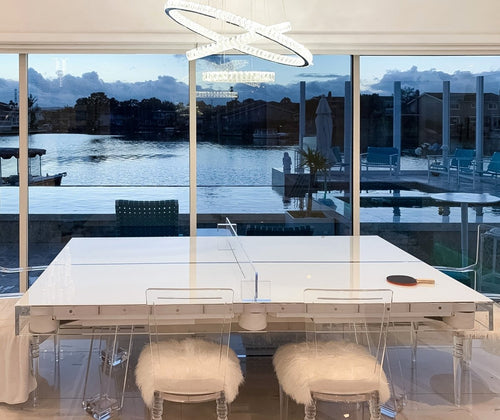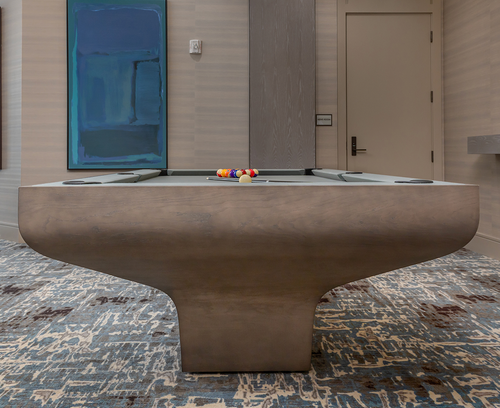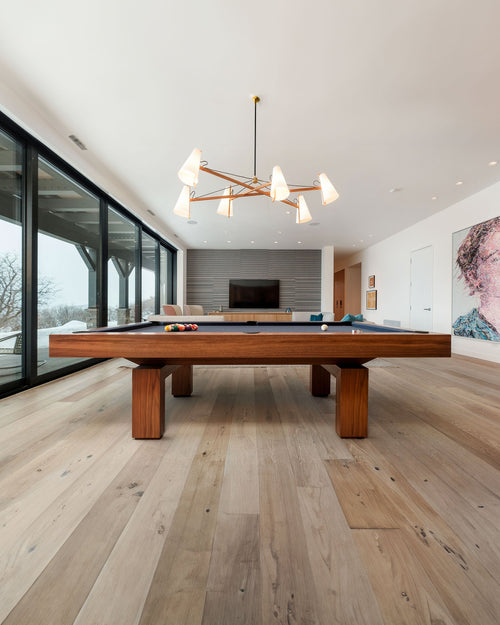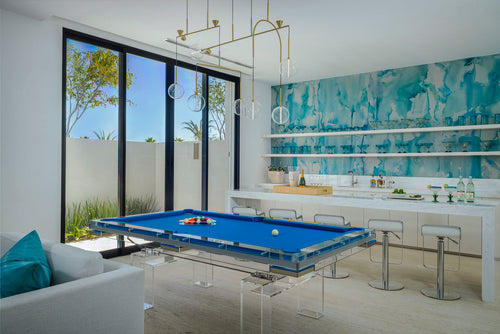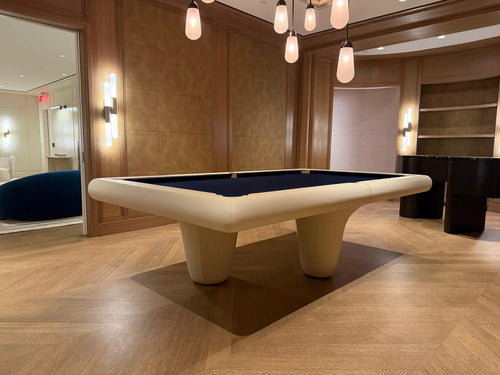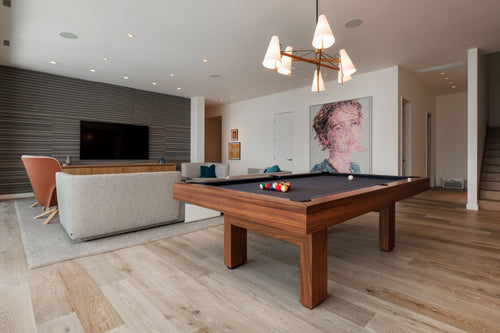


Enjoy our modern designs
A ping pong conversion top creates a temporary table tennis surface over a pool table, dining table, or another sturdy base. It can preserve valuable floor space, but it also introduces overhang, lifting, storage, and surface-protection concerns that do not exist with a dedicated table.
A successful setup depends on more than whether the top technically fits. The support table must carry the load safely, the panels must remain aligned, and every contact point must protect the furniture beneath it.
1. Choose Full-Size or Compact Dimensions
A regulation table tennis surface measures 9 feet long by 5 feet wide. Full-size conversion tops reproduce those dimensions, while compact versions reduce the playing area to fit smaller rooms and simplify storage.
A compact top can be suitable for casual rallies, children, and limited spaces. It will not reproduce regulation distances, angles, or movement around the table. Decide whether space efficiency or conventional play is the greater priority.
Mark the full dimensions on the floor and add player clearance. The room needs space beyond both ends for serves and deeper shots, as well as side clearance for movement and ball retrieval.
2. Verify Support-Table Compatibility
The underlying table must be level, rigid, and strong enough to support the conversion top. Do not assume that a large dining table is structurally suitable. Folding leaves, pedestal connections, glass inserts, decorative extensions, and lightweight aprons can limit safe loading.
For a pool table, compare the conversion top with the outside rail dimensions, not only the slate playing area. Identify exactly where the underside pads, blocks, or braces will rest.
Confirm these details:
- The permitted minimum and maximum base size.
- The location of every underside contact point.
- The amount of unsupported overhang at each end and side.
- Whether net clamps can attach without touching finished rails.
- Whether pockets or decorative trim interfere with supports.
- The load guidance provided by the support-table manufacturer.
Design note: Draw the conversion top and support table to scale. Mark every pad and brace. This quickly reveals whether an underside component will land on cloth, a pocket opening, or unsupported trim.
3. Compare Thickness, Seams, and Bounce
Conversion tops are commonly made from engineered wood panels with a coated playing surface. Thicker and better-braced panels generally flex less and produce a more uniform bounce, particularly across areas that extend beyond the support table.
Some tops use two large halves, while others fold or separate into four smaller panels. Larger sections reduce the number of seams but require more storage space and greater control during lifting. Smaller pieces are manageable but create additional joints that must remain flat.
Inspect or verify:
- Panel thickness and underside reinforcement.
- Flatness across each section.
- Quality of edge banding and corner protection.
- Hinges that sit below or outside the playing plane.
- Connectors that prevent sections from spreading.
- A matte, even finish without raised graphics.
A conversion top is primarily a space-saving recreational solution. Even a good model may not match the bounce of a substantial dedicated table because seams, overhang, and the support base affect its response.
4. Evaluate Alignment and Net Systems
The sections should align without a ridge or gap at the center. Dowels, brackets, hinges, or locking tabs may be used to maintain position. Loose panels can separate during play or shift when a player brushes the edge.
The net system must fit the conversion top without damaging it or the furniture below. Clamp pressure should be applied to reinforced panel edges. Avoid makeshift clamps that contact a finished pool-table rail.
Check whether the net remains centered when the sections move slightly. A net post that doubles as the only panel connector may not provide enough control for a large top.
If the top includes foam blocks that locate it against a pool table, confirm that they fit your rail shape and do not press against pockets or aprons.
5. Plan for Weight and Safe Handling
Full-size panels are awkward even when their listed weight appears manageable. Width, reach, and limited handholds can make a panel difficult for one person to control.
Plan for two-person installation unless the manufacturer provides a safe one-person system. Before lifting:
- Clear the entire route from storage to the base.
- Remove watches, belt hardware, and jewelry that could scratch a finish.
- Inspect handles, hinges, and panel edges.
- Agree on the direction of movement and set-down point.
- Lift with the panel upright only when the design permits it.
- Lower the panel into place instead of sliding it across the base.
Keep fingers out of folding seams. Never lift a section by its net, edge trim, hinge, or alignment pin.
Design note: Before buying, simulate the panel dimensions with a lightweight cardboard sheet. Carrying it through the intended route reveals turning and reach problems that a weight specification cannot show.
6. Protect a Pool or Dining Table
Never place a conversion top directly on pool-table cloth or finished wood without a compatible protective system. Contact points should be nonabrasive, non-staining, clean, and firmly attached to the conversion top.
Soft fabric alone may not distribute concentrated loads from hinges, screws, or support blocks. A rigid fitted dining top or another manufacturer-approved intermediate layer can provide better protection for some pool tables.
Before every setup:
- Remove chalk and grit from the pool-table rails and protective surface.
- Inspect the conversion top’s underside for exposed fasteners.
- Check that foam pads have not shifted, hardened, or collected debris.
- Confirm that no load rests on pocket liners or unsupported cloth.
- Verify that the top cannot slide during play.
A dining table may need different protection. Some foam and rubber materials can react with wood finishes if left in contact for extended periods. Use materials approved for the particular finish and remove the conversion top after use.
7. Create a Safe Storage System
Improper storage can warp panels, damage edges, and create a tipping hazard. Follow the manufacturer’s recommended orientation. If vertical storage is permitted, use a rack that supports the panel at several points and restrains it from falling.
Place clean protective separators between finished faces. Keep hinges and metal connectors from contacting another panel. Store the net and small hardware in a closed, labeled container.
The storage area should be:
- Dry and protected from floor moisture.
- Away from direct sunlight and heating equipment.
- Stable in temperature and humidity.
- Clear of vehicle doors, bicycles, and moving equipment.
- Inaccessible to children who could pull a panel forward.
Do not lean panels loosely against a wall or place heavy boxes on a horizontally stored top. Support should be even enough to prevent a long panel from sagging.
8. Decide Whether a Conversion Top Is Practical
A conversion top works best when the support table is rarely needed during a game, two capable people can install the panels, and a dedicated storage rack is nearby.
A folding ping pong table may be the better choice when:
- The conversion top would need to be carried up or down stairs.
- The support furniture has a delicate or uncertain load capacity.
- Only one person will handle setup.
- Panel storage would be improvised.
- Consistent practice-level bounce is a priority.
- The pool table must remain readily available.
Design note: Include setup time in the decision. A conversion top that is difficult to retrieve, assemble, align, and store may receive far less use than expected.
The Bottom Line
A good ping pong conversion top fits the support table precisely, controls panel movement, distributes its weight safely, and includes effective nonabrasive padding. Confirm the lifting and storage plan before purchase. Size efficiency is useful only when the top can be installed without risking injury, warping, or damage to the furniture beneath it.