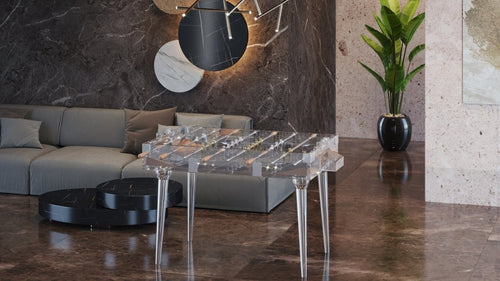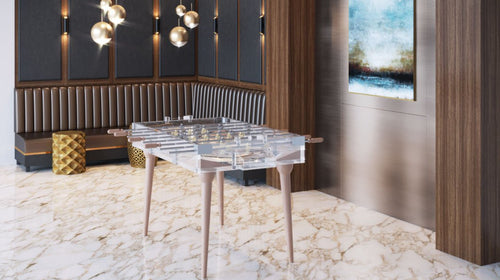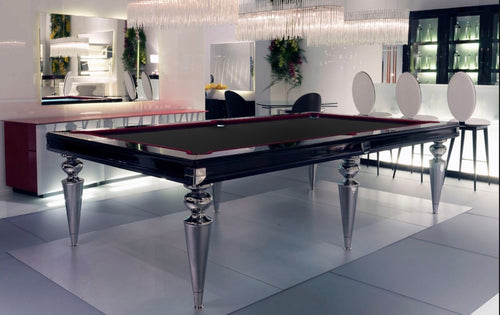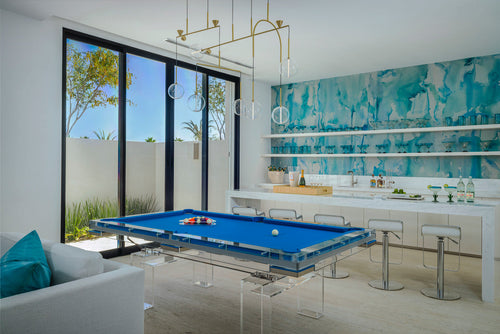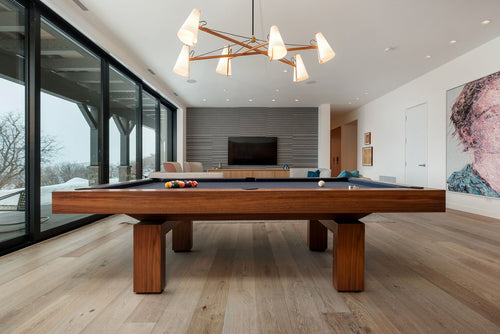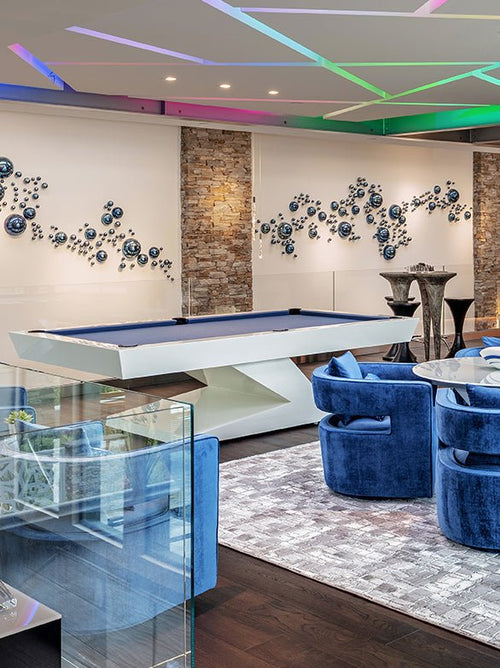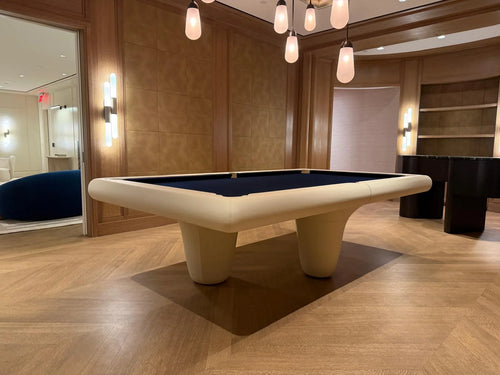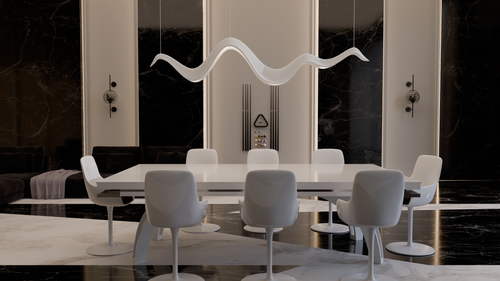


Enjoy our modern designs
Stop putting $500 cues in a $50 rack. It’s time to match the quality of your game.
You wouldn’t put a bumper sticker on a Ferrari. Yet, every day, I see game rooms featuring $10,000 mahogany tables and $2,000 carbon-fiber cues... with the equipment stored in a wobbly, particle-board rack bought from a big-box store.
There is a misconception that a cue rack is just a utilitarian accessory—a bracket to hold sticks. This is false. The rack is the visual anchor of the room and the guardian of your gear.
When you break down the construction, materials, and design, custom cue racks are not just "fancier"—they are objectively superior products. Here is why the upgrade isn't a luxury; it’s a necessity.
Table of Contents
1. The Material Reality: Hardwood vs. "Wood-Look"
Mass-produced racks are almost exclusively made of MDF, or Medium-Density Fiberboard, covered in a thin vinyl veneer.
- The Problem: MDF is essentially glued sawdust. It hates moisture. If your game room is in a basement, which many are, humidity changes will cause MDF to swell and the veneer to peel. Furthermore, screws strip out of MDF easily. Over time, the clips holding your cues will loosen, wobble, and fail.
- The Custom Advantage: A custom rack is built from solid hardwood—Walnut, Oak, Maple, or Cherry. Solid wood has a grain structure that holds screws tight for decades. It bears weight without sagging. It doesn't peel. It ages; it doesn't decay.
2. The "Uncanny Valley" of Aesthetics
Nothing kills the vibe of a high-end game room faster than mismatched wood stains.
- The Problem: You bought a table with a "Traditional Mahogany" finish. You buy a mass-produced rack labeled "Traditional Mahogany." They will not match. One will be redder, the other browner. When placed in the same room, they clash. It creates a subconscious feeling of cheapness or disorder.
- The Custom Advantage: A custom maker doesn't guess; they match. You provide a sample of your table’s finish, and they mix a custom stain to achieve visual continuity. The rack ceases to be an accessory and becomes an extension of the table itself. It ties the room together rather than fragmenting it.
3. Engineering to Your Specific Geometry
Mass-produced racks are "one size fits all," which usually means "one size fits none."
- The Problem: Standard racks assume you have a standard ceiling height and a standard number of cues, usually 6 or 8. If you have a low basement ceiling, a standard floor rack might not fit certain cues. If you have a narrow wall, a standard wall rack might dominate the space or block a light switch.
- The Custom Advantage: A custom rack is built to your blueprints.
- Have a weird nook? A custom builder can create a corner unit that fits the exact angle.
- Collect specialized cues? You can request felt-lined clamps specifically sized for snooker cues, which have a smaller diameter, or break cues, which have a larger butt.
- Need integrated tech? Custom racks can include routed channels for LED lighting to showcase your cues, or built-in digital scoreboards.
4. Preservation of Equipment
This is the functional clincher.
- The Problem: Cheap racks use generic plastic clips. These clips often have sharp mold lines that can scratch the finish of your cues every time you snap them in or pull them out.
- The Custom Advantage: Custom racks prioritize preservation. They use rubberized, felt-lined, or leather-wrapped holders. They are designed with the specific taper of your cues in mind, ensuring a hold that is secure but gentle.
The Verdict
A mass-produced rack is a disposable item. It is designed to be flat-packed, shipped cheaply, and replaced in five years.
A custom rack is architectural furniture. It respects the investment you’ve made in your table and your cues. It elevates the room from a "play area" to a "gentleman’s lounge."
If you care about the integrity of your room and the longevity of your equipment, there is no debate. Go custom.