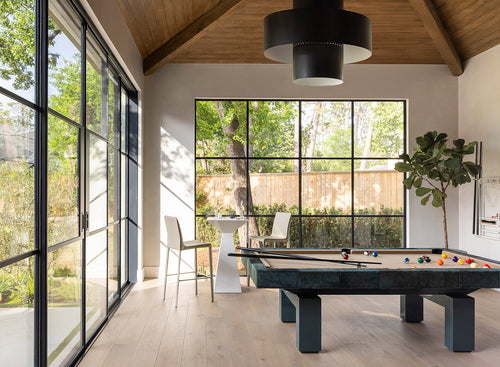


Enjoy our modern designs
How a Simple Storage Tool Became a Design Statement
Cue racks may seem like simple storage, but their evolution says a lot about the history of billiard rooms themselves. What began as a practical way to keep cues from falling over eventually became part of the room’s furniture, culture, and visual identity.
Table of Contents
- 1. When Cues Leaned Against the Wall
- 2. The Victorian Era: Furniture First, Equipment Second
- 3. Early 1900s: Standardization and Commercial Billiard Culture
- 4. Mid-Century America: Function Over Ornament
- 5. The Home Game Room Boom: 1970s–1990s
- 6. The Modern Era: From Storage to Design Object
- 7. Vertical, Horizontal, Freestanding: The Design Languages of Racks
- 8. Cue Racks as Cultural Signals
- 9. From Utility to Identity
When Cues Leaned Against the Wall
A cue rack solves a practical problem: keeping long, slender playing equipment organized and protected between games. Establishing when racks first appeared requires dated inventories, catalogues or surviving objects; it is too strong to say that formal racks did not exist in the early 1800s.
The changing scale of private rooms and public halls helps explain different storage needs. The following periods are a broad design overview, not a documented invention timeline for every rack style.
The Victorian Era: Furniture First, Equipment Second
By the mid-to-late 1800s, cue racks began to appear as permanent pieces of furniture. These early racks were almost always made of solid hardwood and designed to match the heavy, ornate interiors of Victorian billiard rooms. Dark oak, mahogany, carved columns, and brass hooks were common.
These racks were typically wall-mounted, with gravity doing the work. Butts rested in shallow holes at the bottom, shafts leaned into curved slots above. The goal wasn’t just storage — it was presentation. A wall of upright cues signaled respectability. It told patrons this was a serious billiard room, not just a drinking hall with a table.
At this stage, cue racks were more furniture than sports equipment.
Early 1900s: Standardization and Commercial Billiard Culture
As billiard halls spread across the U.S. and Europe in the early 20th century, cue racks became standardized commercial products. Manufacturers began producing:
- floor-standing racks for large halls
- high-capacity wall racks for busy rooms
- numbered slots for player organization
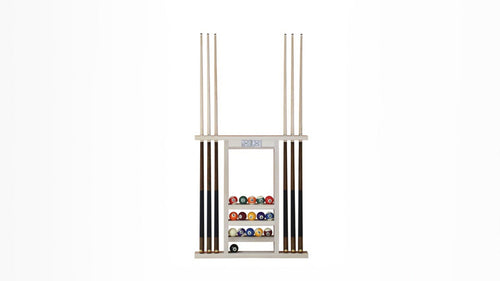
- integrated ball and triangle storage
Racks were now designed for volume and durability, not just elegance. The billiard boom meant dozens of cues cycling through a room daily. Storage had to be efficient.
The Billiard Congress of America was established in 1948, later than this early-1900s phase. Its history identifies an official rulebook as an early objective; it does not establish that the BCA standardized cue-rack dimensions or caused particular rack layouts.
Cue racks became infrastructure.
Mid-Century America: Function Over Ornament
By the 1940s–60s, design philosophy shifted across all furniture, and cue racks followed. Post-war billiard rooms favored simplicity and economy. Gone were elaborate carvings. In came straight lines, lighter woods, and mass production.
Metal hardware became more common. Some racks were entirely steel. Coin-operated pool halls demanded equipment that could survive abuse, theft, and nonstop use. The cue rack became a purely utilitarian object — a tool to hold sticks, nothing more.
This era burned cue racks into popular culture: smoky rooms, neon beer signs, jukeboxes in the background, plain wooden racks bolted to brick walls.
The Home Game Room Boom: 1970s–1990s
As suburban homes expanded and basements became entertainment spaces, cue racks migrated from public halls into private houses. This changed everything.
Homeowners wanted racks that:
- matched furniture
- looked decorative
- stored personal cues safely
- displayed the game as a lifestyle choice
Manufacturers responded with wall-mounted racks shaped like shields, Roman columns, and stylized crests. Stained woods, brass accents, and integrated lighting became common. Cue racks stopped being invisible utilities and became decor pieces.
At the same time, freestanding floor racks grew popular for larger rec rooms. They made cues accessible from all sides and doubled as visual centerpieces near the table.
The Modern Era: From Storage to Design Object
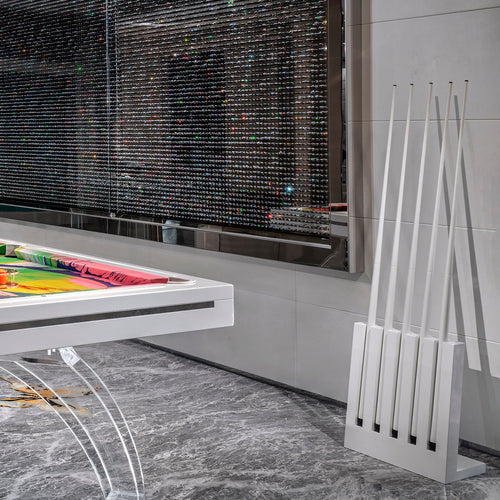
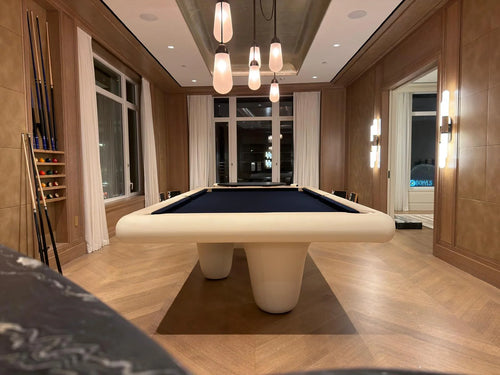
Today, cue racks exist at the intersection of equipment engineering and interior design. You’ll find everything from industrial steel vertical mounts to minimalist floating wall racks carved from a single slab of hardwood.
Modern racks prioritize:
- precise cue alignment
- shaft protection
- storage appropriate to the room’s conditions
- modular mounting
- minimalist aesthetics
A rack can support and organize cues, but ordinary open storage does not control humidity. Choose a design suited to the cues and manage the room environment separately; wood exchanges moisture with the surrounding air, as explained by Oregon State University Extension.
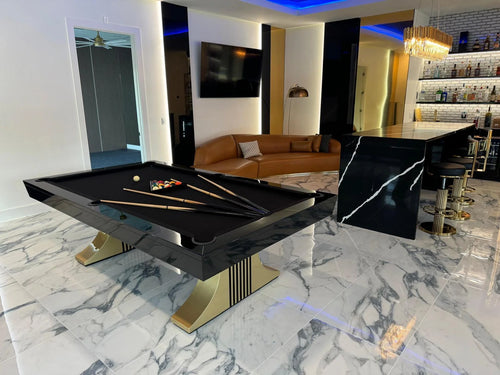
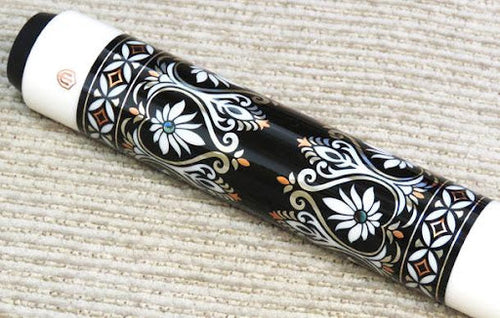
In ultra-luxury game rooms, cue racks are often custom-built to match architectural millwork. Hidden magnets, recessed LED lighting, and carbon-fiber accents appear more often than anyone would’ve imagined a century ago.
Vertical, Horizontal, Freestanding: The Design Languages of Racks
Across eras, three dominant rack styles emerged and survived:
Vertical wall racks — a space-efficient option, still favored in halls and home installs.
Horizontal racks — popular in modern minimalist rooms, emphasizing display over density.
Freestanding racks — a product of large rooms, prestige, and accessibility from all sides.
Each style reflects not just a storage solution, but a statement about how the room is meant to be used and seen.
Cue Racks as Cultural Signals
Cue racks quietly reveal how billiards is perceived in a space.
In a commercial pool hall, the rack says:
“This is a working room. Get your cue and play.”
In a high-end private game room, the rack says:
“This is a crafted environment. Respect the process.”
In a minimalist design loft, the rack says:
“This is an art object as much as a sports tool.”
The rack has become a visual shorthand for how seriously the space takes the game.
From Utility to Identity
What began as a way to stop cues from falling over matured into a piece of cultural furniture that mirrors the evolution of billiards itself. From Victorian woodwork to post-war industrial steel to modern architectural minimalism, cue racks have followed every shift in how we design, play, and value the game.
They don’t get the attention that tables or cues do. They don’t decide victories. They don’t impact physics.
But they frame the environment in which the game lives. They protect the tools of the craft. And they tell visitors, silently, what kind of room they’ve stepped into.