

Enjoy our modern designs
Estimated read time: 7 minutes | Fact-checked:
Game Room Planning Guide
How big is a poker table? A full-size oval model is commonly between 84 and 96 inches long, but there is no single official dimension used by every manufacturer or card room. The right size depends on the number of players, whether the game is self-dealt, and how much room remains after the chairs are pulled out.
These are useful shopping ranges—not official universal standards. Always compare the manufacturer’s exact measurements with your room, chairs, doorways and intended seating capacity before purchasing.
There Is No Single Standard Poker-Table Size
The phrase “standard poker table” usually refers to a general category rather than a regulated measurement. Commercial casino tables, portable tournament tables, custom furniture and convertible dining tables can all have different dimensions.
For perspective, full-size commercial-style models are often close to 96 inches long, while compact self-dealt tables may be closer to 66 or 72 inches. Seating claims also vary because chair width, cup-holder placement, a dealer station and the shape of the rail all affect the usable space.

| Table style | Common dimensions | Typical use |
|---|---|---|
| Full-size oval | 84–96 in. long 42–48 in. wide |
Approximately 8–10 player positions, depending on design |
| Compact oval or pub | 66–84 in. long 40–45 in. wide |
Approximately 6–8 players and self-dealt games |
| Round | 48–60 in. diameter | Approximately 4–8 players, depending on chair and rail width |
| Octagonal | 48–58 in. across | Often 6–8 players, with one position at each side |
Treat player capacity as a guide rather than a guarantee. Ten narrow chairs may fit around a table that feels crowded with ten wide, armed chairs.
Oval, Round or Octagonal?
Oval tables
An oval table is the familiar choice for Texas Hold’em, tournaments and larger home games. Its long shape creates room for more players and can accommodate a dedicated dealer position. The tradeoff is reach: players at opposite ends may have difficulty gathering cards or chips without a dealer.
Round tables
Round tables keep every player relatively close to the center, making them practical for self-dealt games and smaller groups. They also fit naturally in square rooms. However, a large round table can become difficult to reach across, so bigger is not always better.
Octagonal tables
An octagonal table gives each player a visually defined section of rail. It is a familiar home-game format and often includes one cup holder per side. Its angular shape is distinctive, although it may not use floor space as efficiently as a compact oval.
Measure the Room With the Chairs Pulled Out
A poker table that technically fits inside a room may still be uncomfortable to use. As a practical starting point, allow at least 36 inches of clearance between the table edge and the nearest wall or piece of furniture.
Where people need to walk behind occupied chairs, aim for approximately 42–48 inches if the room allows it. Door swings, cabinets, stairs and main walkways may require additional clearance.
Simple minimum-room formula
Add 72 inches to the table’s length and 72 inches to its width. That provides approximately 36 inches of clearance on every side.
| Table size | Minimum room with 36-in. clearance | More comfortable target |
|---|---|---|
| 66 × 44 in. | About 11 ft 6 in. × 9 ft 8 in. | About 12 ft 6 in. × 10 ft 8 in. |
| 84 × 42 in. | About 13 ft × 9 ft 6 in. | About 14 ft × 10 ft 6 in. |
| 96 × 48 in. | About 14 ft × 10 ft | About 15 ft × 11 ft |
| 60-in. round | About 11 ft × 11 ft | About 12 ft × 12 ft |
The “more comfortable” examples use approximately 42 inches around the table. Actual requirements depend on chair depth, traffic patterns and local accessibility or building regulations.

Do a chair test before ordering
Mark the table footprint on the floor with painter’s tape. Place one of the chairs at the edge, pull it out as if someone were standing up, and then walk behind it. This quick test reveals problems that a room measurement alone can miss.
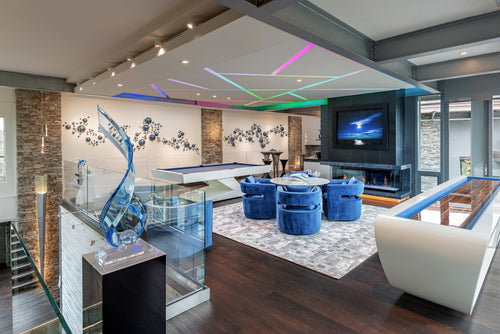
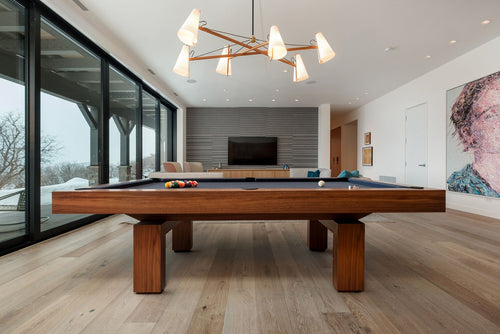
If the poker table will share a room with billiards or other games, account for the playing clearance required by each activity. A coordinated game room set can make it easier to plan seating, storage and circulation as a complete space.
The Features That Matter Once the Cards Are Dealt

Padded rail
The padded perimeter supports players’ forearms during long sessions. A wider rail can feel more luxurious, but it also increases the table’s outside dimensions and places players farther from the center.
Playing cloth
“Felt” is often used as a general term, but many purpose-built poker tables use a smoother synthetic speed cloth. The surface should allow cards to slide without being so slick that chips move too easily.
Cup holders
Cup holders help keep drinks away from the central playing area. Check their diameter and depth if you regularly use mugs, stemware or insulated tumblers. Position matters too: holders built into a wide rail may reduce each player’s usable elbow room.
Racetrack
A racetrack is the hard perimeter between the rail and playing cloth. It provides a dedicated place for chips and drinks, but cards do not slide across it as smoothly as they do across cloth. Some players prefer a continuous playing surface for that reason.
Dealer position
A dedicated dealer station may include a chip tray, card shuffler, drop box or recessed working area. It is useful for dealer-run games but consumes space that could otherwise become another player position.
Base and knee clearance
A table can have generous outer dimensions and still feel cramped underneath. Confirm the distance between legs or pedestal supports, especially if you intend to use wide chairs or seat players at both ends.
Materials Determine How the Table Ages
- Plywood or engineered wood: Common in portable and commercial tables because it can provide strength without excessive weight. Quality and thickness vary considerably.
- Solid wood and veneer: Often used on furniture-style tables where finish and appearance are priorities.
- Metal frames: Can provide rigid support and suit contemporary interiors.
- Vinyl rail upholstery: Easy to clean and available in many colors. Look for tight seams and firm, even padding.
- Leather or premium upholstery: Offers a distinctive appearance but may require more careful maintenance.
Stability matters more than material names alone. Check how the rail attaches, whether the playing surface can sag, how firmly the base connects to the top, and whether replacement cloth or upholstery can be installed later.
Customization Should Support the Way You Play
Custom felt colors, logos, integrated lighting and USB charging can make a table personal, but the layout comes first. Decide how many people you normally host, whether a dedicated dealer is used, and where drinks and chips will sit before selecting decorative details.
A convertible poker-and-dining table can make sense in a multifunctional room, but check both sets of dimensions. Adding a dining top may increase the overall width, height and weight of the table.
For unusual dimensions, finishes, rail profiles or convertible designs, start with our custom-design service.
Choose the Room Before You Choose the Table
- Measure the complete room. Record the length, width and ceiling height.
- Mark permanent obstacles. Include doors, windows, cabinets, columns, radiators and stairs.
- Set your real player count. Size the table for the group you host regularly—not the largest game you might hold once.
- Add the chairs. Use their actual width and pulled-out depth rather than assuming every chair is the same.
- Protect the walkways. Leave more room near entrances and routes people will use during play.
- Check delivery access. Measure the doorway, hallway, stairway and any tight turns between the entrance and the finished room.
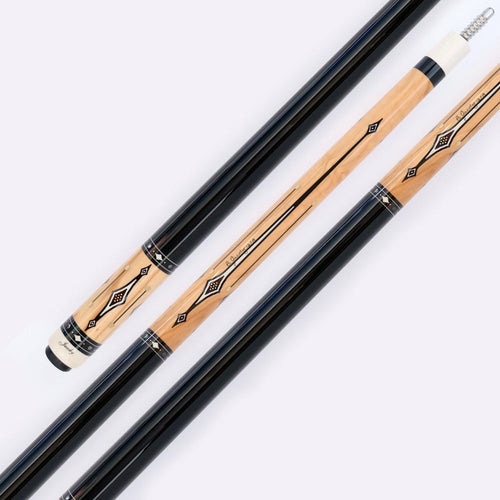
If you are furnishing the entire space, explore our game tables and game room sets. In rooms that also contain a pool table, a wall-mounted cue rack can keep cues off the floor without taking up valuable playing space.
Poker-Table Size Questions
What is the standard size of a poker table?
There is no single universal standard. Full-size oval tables are commonly around 84–96 inches long and 42–48 inches wide, while compact tables can be considerably shorter.
How much room should I leave around a poker table?
Begin with at least 36 inches between the table edge and nearby walls or furniture. Where people must walk behind occupied chairs, approximately 42–48 inches is more comfortable.
What size poker table works for eight players?
Many tables between approximately 72 and 84 inches long are marketed for eight players. Comfort depends on rail shape, cup-holder placement and chair width, so check the actual seat spacing before ordering.
How tall is a poker table?
Purpose-built poker tables are often approximately 28–30 inches high. Furniture-style and convertible tables may be taller, so confirm that the chairs and armrests will fit comfortably beneath the rail or apron.
Is a round or oval poker table better?
Round tables are convenient for smaller self-dealt games because players remain close to the center. Oval tables accommodate larger groups more easily and are better suited to games with a dedicated dealer.