

Enjoy our modern designs
Most conversations about outdoor pool tables start and end with weather resistance. That makes sense on the surface. If a table is going outside, it needs to handle sun, rain, humidity, temperature changes, and the general abuse that comes with open-air living.
But weather resistance is only the first requirement. It is not the whole story.
A table can technically survive outdoors and still be wrong for the space. It can resist moisture but feel awkward on the terrace. It can use durable materials but play poorly. It can be built for exposure but look like patio equipment instead of luxury furniture.
The best outdoor pool tables are not simply indoor tables made tougher. They are designed for a different kind of environment, one where architecture, landscape, climate, entertaining, and performance all overlap.
Table of Contents
- 1. Weather Resistance Is the Starting Point
- 2. Sun Is Often the Bigger Enemy
- 3. The Ground Matters More Than People Think
- 4. Outdoor Does Not Mean Casual
- 5. The View Changes the Table
- 6. Clearance Still Rules the Space
- 7. Covers Are Not an Afterthought
- 8. The Table Has to Work With Outdoor Furniture
- 9. Outdoor Lighting Has Two Jobs
- The Bottom Line
1. Weather Resistance Is the Starting Point
An outdoor pool table has to be engineered for conditions that would quickly damage a traditional indoor table. Moisture can warp wood. Sun can fade finishes and felt. Salt air can corrode metal. Heat can affect materials. Poor drainage can create long-term structural problems.
This is why material selection is so important. The frame, hardware, rails, playing surface, cushions, fasteners, and finish all need to be appropriate for exterior use.
Still, once that baseline is met, the conversation should move further. A luxury outdoor table cannot be judged only by whether it survives rain. That is like judging a yacht only by whether it floats.
The Pro Insight: Outdoor durability keeps the table alive. Good design makes it worth placing there.
2. Sun Is Often the Bigger Enemy
Rain gets most of the attention, but sun exposure can be just as punishing. Outdoor furniture does not only fail because it gets wet. It fails because it gets slowly attacked every day by UV exposure.
This matters for finishes, cloth, cushions, covers, and color choices. A black or dark table may look dramatic against stone or concrete, but it can absorb heat and feel harsh in a fully exposed area. A lighter finish may be more comfortable visually and physically, especially in poolside or coastal environments.
Shade changes the equation. A table under a pergola, covered terrace, or deep overhang has different design possibilities than one sitting in direct sun for most of the day.
3. The Ground Matters More Than People Think
A pool table depends on stability. Outdoors, that begins before the table is even installed.
The surface underneath matters enormously. A flat concrete slab, stone terrace, porcelain paver system, or reinforced deck can support the table properly if it is planned well. Uneven pavers, soft ground, unstable decking, or surfaces with aggressive slope can create problems that no amount of leveling hardware can fully hide.
Outdoor spaces are often built for drainage, which means they may not be perfectly level. That is good for water management, but it complicates pool table placement. A slight slope that feels invisible when walking can become very obvious when balls start drifting across the playing surface.
4. Outdoor Does Not Mean Casual
One of the biggest design mistakes with outdoor pool tables is assuming they should feel casual just because they are outside.
A luxury outdoor space is still part of the home. In many properties, the terrace, pool deck, or covered lounge is one of the most important entertaining areas. Treating the pool table like generic patio equipment weakens the entire setting.
An outdoor table should feel durable, but not crude. It should be strong enough for the environment while still carrying the same level of design intention as the rest of the property.
5. The View Changes the Table
Indoor pool tables usually define the room around them. Outdoor tables often share attention with something bigger: a view.
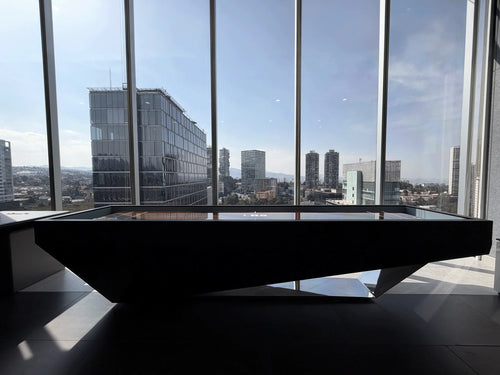
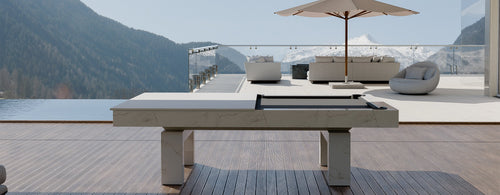
That could be the ocean, a pool, a garden, a city skyline, mountains, a courtyard, or a long architectural sightline through the house. In these spaces, the table should not fight the view. It should help frame the experience.
This affects placement and visual weight. A table with a heavy base may block sightlines if it sits between the house and the landscape. A more open or lighter design may preserve the feeling of space.
6. Clearance Still Rules the Space
Outdoor rooms often feel larger than they really are. Without walls, it is easy to underestimate how much space a pool table needs.
Cue clearance still matters. Circulation still matters. Seating still matters. People still need to pass through the space without walking directly through the playing area. A table squeezed into a terrace may technically fit, but if every shot requires someone to back into a sofa, planter, column, or railing, the space will not feel luxurious.
For a table beside a swimming pool or in a pavilion, review pool-house game-room planning to separate wet traffic from the playing area.
A strong layout gives the table enough breathing room while still connecting it to the social life of the space.
7. Covers Are Not an Afterthought
A cover is often treated as a practical accessory, but for an outdoor table it is part of the ownership experience.
A bad cover can make even a beautiful table look abandoned. It can sag, collect water, fade, crack, or turn the terrace into something that feels more like storage than design. If the table is going to be covered for long periods, the cover needs to be considered visually as well as functionally.
The best approach is to treat the cover as part of the system. It should fit well, protect properly, be easy to use, and not ruin the atmosphere of the space when the table is not active.
8. The Table Has to Work With Outdoor Furniture
Outdoor furniture has changed dramatically. Many high-end terraces now use pieces that feel closer to interior furniture: deep sofas, sculptural lounge chairs, stone tables, upholstered benches, outdoor rugs, low-profile sectionals, and refined dining sets.
The pool table needs to live comfortably in that world. If the surrounding furniture is low, soft, and relaxed, an overly bulky table may feel too hard. If the architecture is sharp and minimal, a traditional table may feel nostalgic in the wrong way.
| Outdoor Factor | Why It Matters |
|---|---|
| Surface | Determines stability, leveling, drainage, and long-term performance. |
| Shade | Protects finishes, cloth, and comfort during daytime use. |
| Furniture | Decides whether the table feels integrated or isolated. |
| View | Influences visual weight, placement, and table silhouette. |
9. Outdoor Lighting Has Two Jobs
Lighting an outdoor pool table is more complicated than simply hanging a fixture above it.
The table needs functional light for play, but the surrounding space needs atmosphere. A pool deck, terrace, or covered lounge should not feel like a garage with a bright task light dropped over the center.
The challenge is balance. Too little light and the table becomes decorative after sunset. Too much light and the outdoor lounge loses its atmosphere. The goal is to let the table glow as part of the space, not blast it into attention.
The Bottom Line
The best outdoor pool table is not the one that simply resists the elements. It is the one that helps the exterior feel designed, furnished, and lived in.
Weather resistance matters, but it should not be the whole pitch. The table also needs the right location, the right surface, the right materials, the right visual weight, the right lighting, and the right relationship to the architecture around it.
When those pieces come together, the outdoor area stops feeling like leftover space. It becomes a real room without walls.