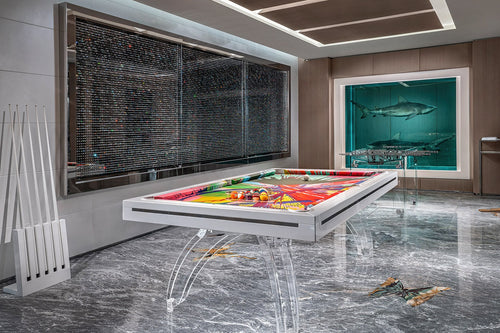

Why So Many Famous People Get Hooked on Ping Pong

Why So Many Famous People Get Hooked on Ping Pong


Culture & Personality


Ping pong has a strange power: it feels casual enough for a basement or green room, but competitive enough to swallow actors, athletes, musicians, and billionaires whole once the first real rally begins.

Table Tennis Culture · Celebrities & Lifestyle · 6 min read

Ping pong has this weird magnetism. It is casual enough to feel harmless, yet deep enough to expose anyone with even a hint of competitiveness. That is why so many famous people—from Oscar winners to NBA stars to tech founders—keep drifting back toward the table.

The Core Appeal

A Hobby That Quietly Hooked the
Famous

Ping pong wipes status away faster than most hobbies. Once the rally starts, nobody cares who has Oscars, rings, Grammys, or a multibillion-dollar company. All that matters is touch, timing, reflexes, and whether you can read the next ball.

That is a huge part of the draw. The game is social without being passive, competitive without needing a stadium, and deep enough to reward repetition. For famous people, that makes it almost perfect: it is private, immediate, and oddly revealing.

The table levels people fast. Fame matters right up until the serve. After that, it is just spin, timing, and whether you can actually play.
— Why ping pong cuts through status
Set Culture

Hollywood’s Notorious Set
Rivalries

Actors love downtime games, and ping pong has become the default choice on sets for a reason. It is compact, fast to set up, and good at turning idle time into low-stakes competition that still feels real.

Tom Hanks is one of the better-known examples. Jamie Foxx has also turned the game into a social ritual, with matches becoming part gathering, part rivalry. Daniel Radcliffe and Emma Watson reportedly used table tennis as a release valve during long production stretches, while Will Ferrell’s attachment to the game fits perfectly with his general taste for turning casual competition into theater.

Why It Works on Set

Ping pong is ideal production downtime because it is fast, indoors-friendly, social, and competitive without requiring the energy or logistics of a full athletic activity.

Backstage Ritual

Musicians Who Warm Up With a
Paddle

Music and ping pong make more sense together than they first seem to. Both rely on rhythm, reaction, tempo control, and repeated micro-adjustments. So it is not that surprising that musicians gravitate toward the game backstage.

Artists like Justin Bieber and Ed Sheeran have both been associated with taking ping pong seriously on the road. Others, like Dua Lipa and members of The Killers, fit into the broader culture of ping pong bars and backstage table setups. Mark Ronson is the perfect type for this too: exactly competitive enough to care more than he should in a supposedly casual setting.

Scene 01
Movie Sets
Why It WorksKills Downtime
EffectFriendly Rivalries

A table gives actors a repeatable ritual that keeps energy up without turning the room chaotic.

Scene 02
Tour Backstage Areas
Why It WorksStress Reset
EffectPre-Show Focus

For musicians, ping pong is active enough to wake the brain up without burning energy meant for the stage.

Scene 03
Athletic Facilities
Why It WorksHand-Eye Test
EffectHumbling Fast

Athletes often assume they will dominate immediately, then discover how specific the sport’s skill demands actually are.

Scene 04
Tech Offices
Why It WorksMental Break
EffectCulture Builder

The table becomes part stress relief, part social lubricant, part office identity signal.

Competitive Respect

Athletes Who Respect the Game’s
Precision

Professional athletes are almost built to underestimate ping pong. They see hand-eye coordination, quick reactions, and a small playing space, so they assume transfer is automatic. Then the spin, pace, and touch immediately expose how sport-specific the game really is.

That is exactly why so many athletes end up respecting it. LeBron James, Kevin Durant, Dwyane Wade, Chris Bosh, Novak Djokovic, Roger Federer, and Serena Williams all fit the type: extremely competitive people who enjoy testing themselves in environments that look simple but are not.

The sport is also useful as a training-adjacent activity. Reflexes, balance, tracking, and precision all get challenged, even if the environment feels playful rather than formal.

Office Mythology

Tech Titans Who Turn Offices Into Ping Pong
Hubs

Ping pong became part of startup and tech-office mythology because it solved multiple problems at once. It gave people a fast mental break, created casual social mixing, and symbolized a company culture that wanted to look energetic and creative rather than corporate and rigid.

That is why names like Elon Musk, Larry Page, Sergey Brin, Mark Zuckerberg, Patrick Collison, and Jeff Bezos fit so naturally into the story. Whether each person was deeply serious about the game or simply part of environments where the table became central, the pattern is obvious: ping pong became a kind of physical shorthand for a particular version of office culture.

The Real Reason

Why Celebrities Keep Coming Back to the
Game

Ping pong does something rare. It strips away the noise around a person and forces a more immediate version of them to show up. Patience, frustration, stubbornness, humor, aggression, touch, rhythm—all of it becomes visible fast.

That makes the game unusually attractive to people whose public lives are otherwise filtered and over-managed. The stakes are small, but the competition feels real. The setting is safe, but the reactions are honest.

That combination is hard to beat. The game is meaningful without being consequential, which is exactly the kind of outlet a lot of high-pressure people end up needing.

// Closing Thoughts

Ping pong will never dominate celebrity headlines, but it keeps showing up in the same places for the same reason: it is one of the rare games that is social, revealing, portable, and genuinely hard to master. When people who can afford any hobby in the world still keep drifting back to a paddle and a plastic ball, that tells you the game has something deeper going on.

The Workshop Review · Famous People and Ping Pong · Culture Series

0 Comments

Leave a comment

Please note, comments need to be approved before they are published.